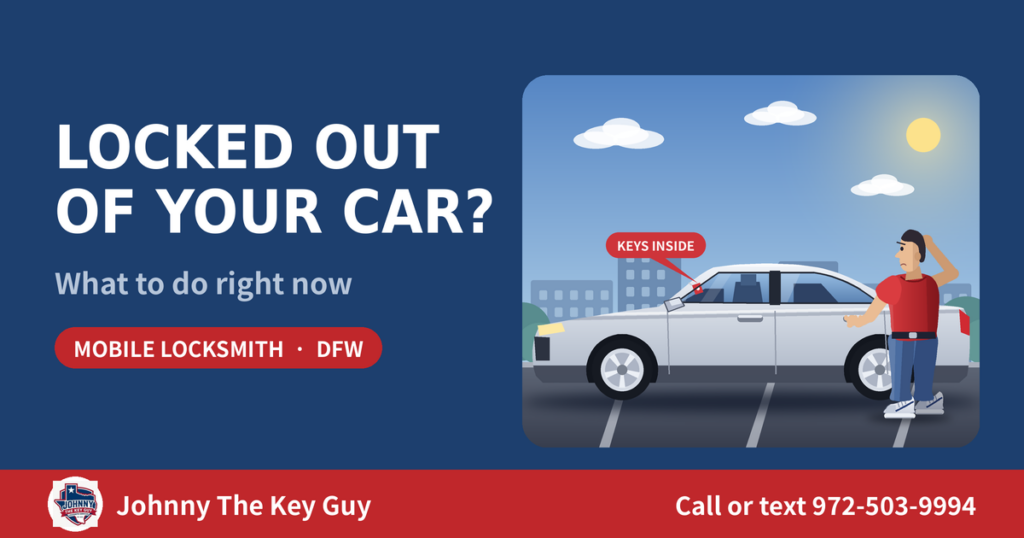
Locked Out of Your Car in DFW? What to Do Right Now
What to do if you're locked out of your car in Dallas–Fort Worth: what to check, what to avoid, and when to call. Call or text 972-503-9994.
Read more →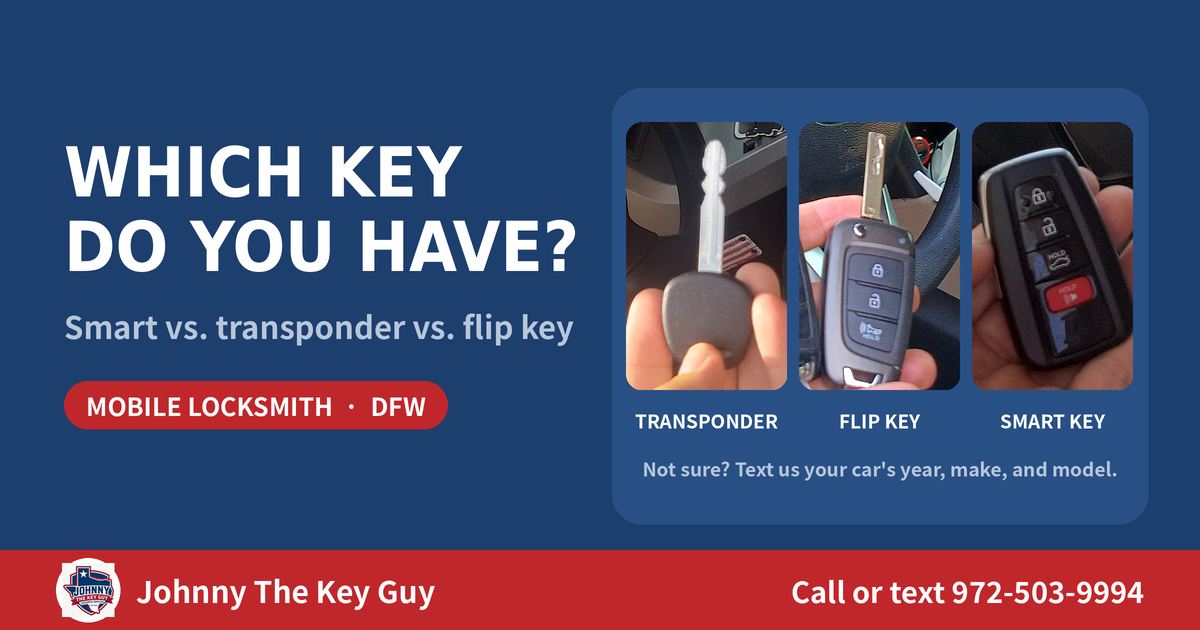
Ask five people what a “car key” is and you might get five different answers. A plain metal key, a plastic-headed key with a chip inside, a key that folds out of a remote, and a fob that never leaves your pocket are all car keys, and they’re very different to replace. Here’s how to tell which one you have and what each one means when you need a new one.
Remote keys and flip keys almost always have a transponder chip inside as well, so they count as both.
A single piece of metal with no electronics. You’ll mostly find these on older vehicles. It’s the simplest key to copy, because it only needs to be cut.
Most cars built since the late 1990s have a small chip in the key head. When you turn the key, the car’s computer reads the chip’s code. If the code isn’t recognized, the engine won’t start, even though the key turns in the ignition. That’s a security feature called an immobilizer.
It’s also the reason a key that was only cut can open the door but won’t start the car. Replacing a transponder key takes two steps: cutting the key and programming it to your car.
A remote key adds lock, unlock, and sometimes trunk or panic buttons to the key head. The blade is fixed, and the key usually has a transponder chip as well. Replacing one generally means cutting the blade, programming the chip, and programming the remote buttons.
A flip key, sometimes called a switchblade key, folds the metal blade into the fob body like a pocketknife. It does the same job as a remote key: a chip for starting the car, buttons for locking and unlocking, and a blade for the door and ignition. The hinge and the buttons are common points of wear, which is a frequent reason people replace them.
A smart key, also called a proximity key or keyless fob, lets the car sense the fob when it’s close. You unlock the door with a touch or a button and start the car by pushing a start button, without putting a key into anything. Most smart keys hide a small emergency blade inside the fob for the door lock, in case the battery dies.
Smart keys are generally the most involved to replace, because the new fob has to be programmed to the car’s security system.
Some keys, including many transponder and smart-key blades, have a thicker blade with a groove cut into the face instead of teeth along the edge. They’re sometimes called laser-cut or sidewinder keys, and they’re cut on a special machine. A basic hardware-store key machine usually can’t cut them.
There’s no single answer, because it depends on your car. In general, the more electronics in the key, the more there is to program, and the more your car’s make, model, and year matter. That’s why we ask for those first, and why we don’t quote one flat price for every key. Our guide on what affects the cost of a replacement car key walks through it.
If you still have one working key, make a spare now. It’s usually simpler than starting over after every key is gone. If you’ve lost every key, tell us right away. We can cut and program a new key where the car is parked, so you don’t need a tow. You can see everything we do on our car key services page.
Can I program a key myself?
Some vehicles let you program an extra remote using steps in the owner’s manual. Keys with chips and smart keys usually need special equipment.
Can a dead fob battery stop my car from starting?
It can. Many cars have a backup way to start with a weak fob, and your owner’s manual shows how. Replace the battery soon after.
Can you make a key without the original?
Yes. Most car keys can be cut and programmed from the vehicle alone, so no original key is needed.
Do you work on my car?
We work on most makes and models, including Mercedes-Benz. We generally don’t work on other German brands such as BMW, Audi, or Volkswagen. Text us the year, make, and model and we’ll tell you honestly.
Do you come to me?
Yes. We serve the whole Dallas–Fort Worth area. See the cities we cover.
Need a key made or replaced? Call or text Johnny at 972-503-9994, Sunday through Friday, 8am to 6pm.
WordPress can publish a post on a date you choose, so you can paste both in during one sitting. In the editor, click “Publish immediately” and set the date and time. I’d use Mon Oct 12 at 10 AM for the lockout guide and Mon Oct 19 at 10 AM for the smart key one. Set the slugs above exactly, add a job photo as the featured image, and paste each excerpt.
Once you’ve scheduled them, send me the two page addresses WordPress shows. I’ll schedule matching Facebook posts for those days. I didn’t schedule them yet because a Facebook post with a wrong or not-yet-live link would send people to an error page.
Call or text Johnny. Open Sun – Fri, 8am – 6pm.
What to do if you're locked out of your car in Dallas–Fort Worth: what to check, what to avoid, and when to call. Call or text 972-503-9994.
Read more →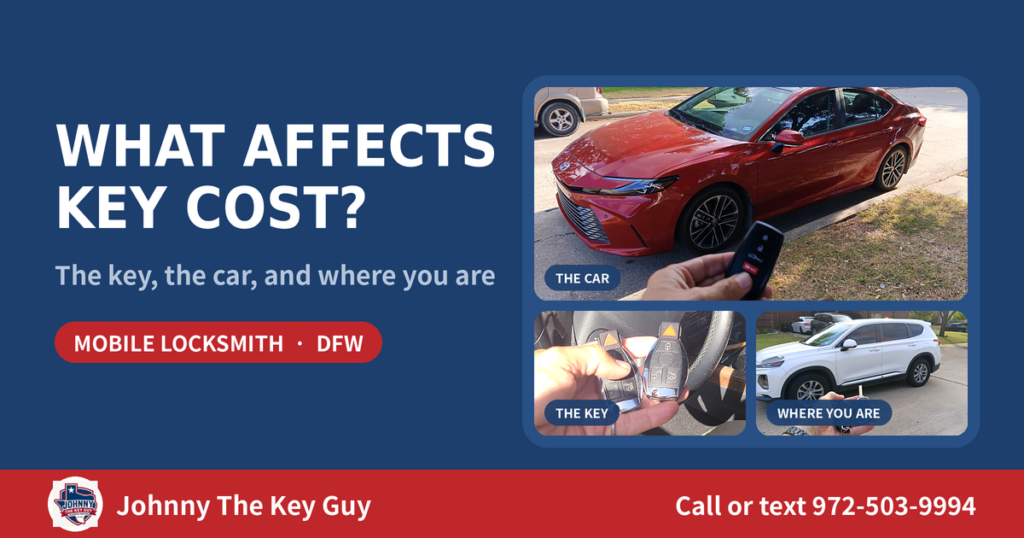
What to do right now if you’ve lost your car key If you’ve lost your only car key, the first thing you want to know is the price.…
Read more →We can be on our way in minutes.
Open Sun – Fri, 8am – 6pm